miércoles, 30 de marzo de 2011
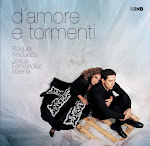
CRITICA DE BERNARD GORDILLO DEL DISCO D'AMORE E TORMENTI
But unlike its counterparts, the aria was a child of the Renaissance and an immediate beneficiary of opera (an Italian invention), with its classical themes of passion, unrequited love/lust, and besotted lovers providing inspiration for many a composer and performer.
Recordings with programs made up of entire early-Italian baroque song are commonplace in today’s market, with selections dating back at least four decades. There are some notable ones, mainly associated with famous names and duos, but few of the lesser-known ensembles come to mind when summoned.
I became aware of soprano Raquel Andueza and theorbist Jesús Fernández Baena as a duo just recently. On receiving a copy of their recording D’amore e tormenti (NB Musika) I had an idea of what to expect as far as Andueza was concerned (I’d been bowled over already by her gorgeous voice and impeccable musicianship in recordings with Private Musicke and More Hispano). Yet her CD with Baena is something quite special.
The duo chose a varied program of laments, ground basses, and solo theorbo pieces, primarily works that are well-known and performed often. However, the sense of intimacy between the Andueza and Baena is both unique and palpable.
Pieces that I’ve heard over and over again are given life through fresh interpretation, often exuding a feel that’s more improvised than anything else.
Andueza has a seductive tinge of melancholy in her singing that draws you in, not to mention a wide palette of colors she uses to great effect. Baena is as fine a theorbist as I’ve had the pleasure of listening to on recording. His interpretation ofJohannes Kapsberger’s Chiaconna exhibits striking musicianship, as does his excellent accompaniment (full of creative textures).
Speaking of chiaconna’s, it was lovely to discover Ferrari’s Voglio di vita uscir (“I would depart this life”) having only been familiar with Monteverdi’s setting over a similar bass line.
Although I hesitate to draw comparisons, I have to admit that the duo reminds me of the renowned collaboration between Emma Kirkby and Anthony Rooley, whose powerful connection was evident in their many recordings. Whereas Kirkby and Rooley were the definitive performers of early song for their generation, Andueza and Baena are surely at the top of the list for theirs.
BERNARD GORDILLO, www.bernardgordillo.com
domingo, 16 de mayo de 2010
CRÍTICA CONCIERTO D'AMORE E TORMENTI, DIARIO DE SEVILLA

martes, 28 de julio de 2009
CRÍTICA D'AMORE E TORMENTI - REVISTA GRAMOPHONE (julio-agosto 09)

miércoles, 25 de febrero de 2009
CRÍTICA D'AMORE E TORMENTI - REVISTA CD COMPACT (Febrero 09)

No me cansaré de repetir que España ha alumbrado recientemente una prodigiosa generación de cantantes especializados en el repertorio barroco, la mayoría de ellos situados en la treintena, año más, año menos. La punta de lanza de esta formidable plétora la constituyen, a mi modo de ver, tres sopranos: Núria Rial, María Espada y Raquel Andueza. Sin el aparato mediático que ha encumbrado, en no pocas ocasiones sin merecerlo, a algunas divas foráneas (sobre todo, francesas), Rial, Espada y Andueza están hoy entre las mejores cantantes del mundo (al menos, lo que a la interpretación historicista respecta) y no porque lo diga yo, sino porque lo dicen sus agendas.
La gran virutd de este disco es que llega a lo más hondo del corazón, por la paz espiritual que transmite. Quienes nos dedicamos a la crítica tenemos la suerte (o la desgracia, según se mire) de escuchar muchos discos, lo que no nos permite emplear el tiempo que quisiéramos en los que verdaderamente nos gustan. Les puedo garantizar que éste lo estuve escuchando durante cinco días seguidos sin parar y sin tener la más mínima gana de escuchar otra cosa que pudiera distraer un ápice mi atención. Tal era mi grado de embelesamiento, que no ha disminuido para nada, pues en cuanto tengo la más mínima ocasión me vuelvo a poner con él. Contiene dos de las más hermosas obras compuestas por músicos alguno, el Folle è ben che si crede, de Merula con el que se inicia el compacto, y Si dolce è il tormento, de Monteverdi, con el que se cierra. He escuchado infinidad de versiones de ambas y jamás me habían calado tanto (bueno, he de reconocer que hay un Folle è ben de Núria Rial que circula por ahí que también es capaz de hacer resucitar a un muerto). Pero es que el resto de las arias que se incluyen no le van a la zaga en cuanto a belleza.
Pocas veces he escuchado un programa compuesto por piezas tan arrebatadoras y pocas veces las he escuchado tan bien interpretadas como ahora. Estamos ante un disco de ésos que reclaman un lugar de privilegio en nuestra discoteca, un lugar de fácil acceso para poder escucharlo cuando nos querramos aislar del mundo que nos rodea. Por si fuera poco, el envoltorio es realmente soberbio, no sólo por lo documentado de las notas, sino también por el detalle, siempre de agradecer, de que se traduzca al español las arias.